Most families build a house once. The money behind it has usually taken years to save, or will take years to repay. Yet in Indore, a lot of that money gets committed on the strength of a single figure: a rate per square foot, written on one page, with a few lines of fine print underneath.
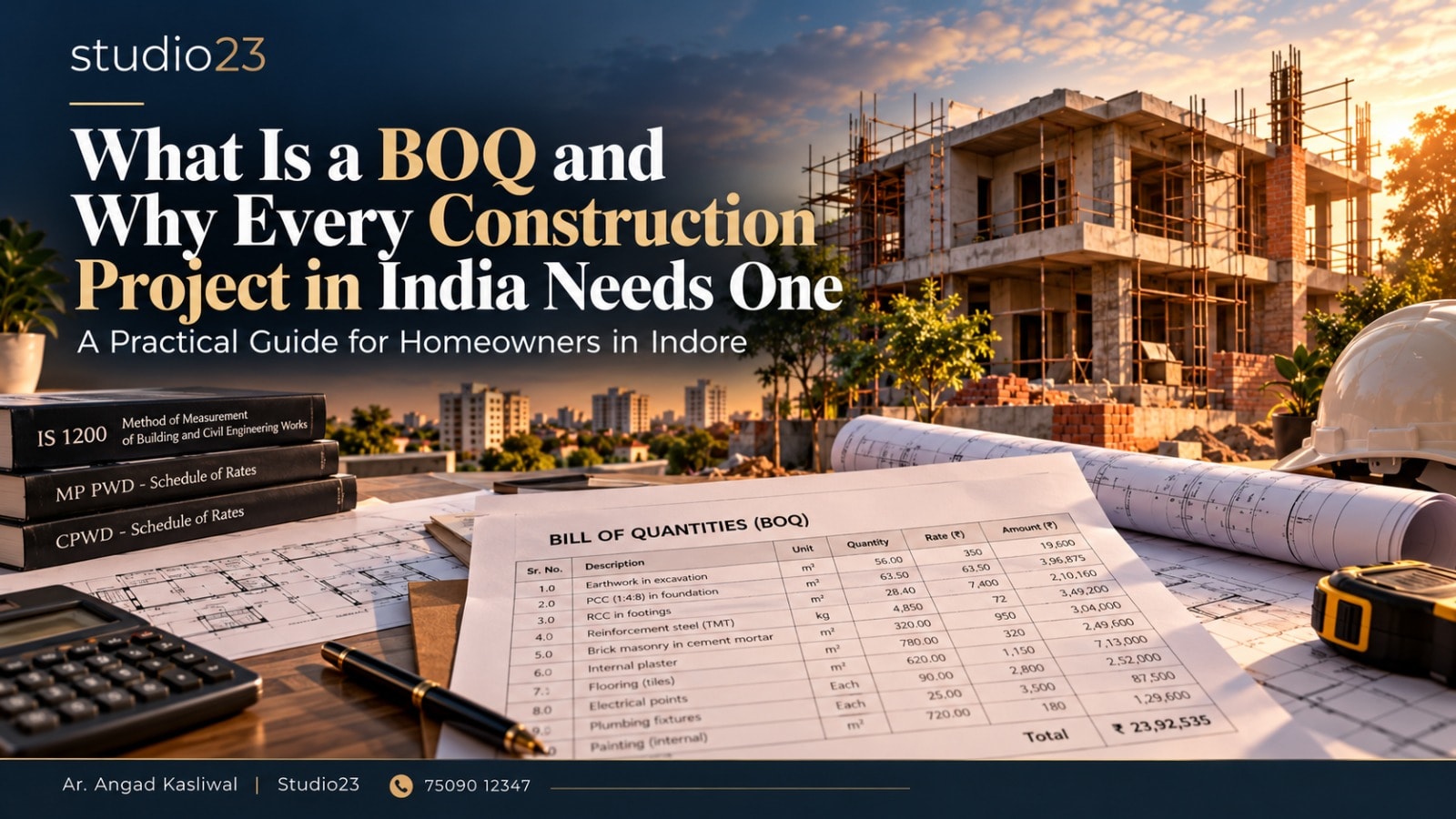
The short answer: A BOQ, or Bill of Quantities, is a line-by-line list of every item of work in a building. Each line says what the work is, the unit it is measured in, how much of it is needed, the rate, and the amount. In India, quantities are measured using the Bureau of Indian Standards code IS 1200. A proper BOQ gives you a price you can check, compare across contractors, and hold someone to. A per-square-foot quote gives you none of that.
This guide covers what a BOQ should contain, how to read one in about fifteen minutes, and how to tell when a BOQ has been written to favour the person who prepared it.
What a BOQ actually is, in plain words
Think of a BOQ as the shopping list for your house, written by someone who measured everything first.
Your drawings show what the house will look like. The BOQ says how much of each thing it takes to build it: cubic metres of excavation, cubic metres of concrete in footings and slabs, kilograms of steel, square metres of plaster, tiles and paint, the number of electrical points, taps and doors.
Every BOQ line has six parts:
- Item number, so everyone can point to the same line.
- Description, saying exactly what is done and with which material, grade or brand.
- Unit, such as cubic metre, square metre, kilogram, running metre or "each".
- Quantity, measured from the drawings.
- Rate per unit, which should state what it includes (material, labour, wastage, scaffolding, lifting to upper floors).
- Amount, which is quantity multiplied by rate.
Add up the amounts and you get the cost of the building. More usefully, you can see where every rupee of that cost comes from.
Why the measuring rules matter
Two people can measure the same wall and get two different numbers. Do you subtract the window opening? Do you count plaster on both faces? The BIS standard IS 1200 settles these questions trade by trade, from earthwork to painting.
A good BOQ states that it follows IS 1200. A weak one says nothing about how anything was measured, which leaves the door open to arguments later.
BOQ vs estimate vs per-square-foot quote
People use these three terms as if they mean the same thing. They don't, and the difference shows up in your bank balance.
| Per-sq-ft quote | Rough estimate | Bill of Quantities (BOQ) | |
|---|---|---|---|
| What you get | One rate multiplied by built-up area | Totals by category (civil, electrical, finishing) | Every item measured and priced separately |
| Based on | Area only | Area plus the preparer's experience | Working drawings and specifications |
| Shows quantities | No | Rarely | Yes, on every line |
| Names materials and grades | A few lines at most | Partly | On every line |
| Lets you compare contractors | Only the headline number | Roughly | Line by line, like for like |
| When something changes | Argued case by case | Argued case by case | Priced at the agreed rate for that item |
| Who carries the risk of gaps | You | Mostly you | Shared, and written down |
Here is how this plays out. Say two contractors quote Rs 1,650 and Rs 1,850 per sq ft for a 2,400 sq ft home. That is Rs 39.6 lakh against Rs 44.4 lakh. Both rates sit inside the standard-finish range in our turnkey construction cost guide for Indore, so neither looks wrong on its face.
The Rs 4.8 lakh gap looks like a saving. It might be. It might also be the boundary wall, the underground tank, terrace waterproofing and half the electrical points, left out of the cheaper quote. Until both contractors price the same BOQ, you cannot tell which.
Why a vague quote is riskier in Indore
Three local realities make a single per-square-foot number a bigger gamble here.
The per-square-foot habit. Most quotes that families bring to our office in Indore are a single rate per square foot, sometimes saman sahit (with material), sometimes labour only. That rate is easy to compare and almost impossible to check.
The soil under your plot. Large parts of Indore sit on black cotton soil, which swells when wet and shrinks as it dries. How deep the foundation goes, and how it is designed, depends on what the soil test shows. That changes the quantities of excavation, concrete and steel, sometimes by a lot. A per-square-foot rate is fixed before anyone has dug a trial pit. A BOQ measured from a structural design based on that test reflects what your plot actually needs.
Government rate books exist, but they are benchmarks. MP PWD publishes a Schedule of Rates (SOR) for building works, and CPWD publishes the Delhi Schedule of Rates (DSR 2023), which is used as a reference across India. Both help you check whether a rate in your BOQ is in a sensible range. They are averages, though. MP's Public Health Engineering Department says so plainly in its own Unified Schedule of Rates: its rates come from state-wide average market rates, local rates vary, and contracts should not be awarded directly on those rates without inviting tenders. The same document notes that its rates already include 10% contractor's profit. Use SOR rates to sanity-check a BOQ, and expect real Indore rates to sit somewhat above or below them.
What a proper BOQ for house construction should contain
Use this as a checklist when a BOQ lands on your table.
- The basis of measurement. A note saying quantities follow IS 1200, and which drawing set and revision they were measured from. If the drawings change later, you will know the BOQ has to change with them.
- Sections by trade or stage. Earthwork, concrete, steel, masonry, plaster, waterproofing, flooring, doors and windows, plumbing, electrical, painting, external works.
- Specific descriptions. "Vitrified tiles 600 x 600 mm, laid on cement mortar bed, including grouting and cleaning, of named brand or approved equivalent" is a line you can hold someone to. "Tiles as per client choice" is a line you cannot.
- Concrete and steel grades named, such as M20 or M25 concrete and Fe 500 or Fe 500D steel, matching the structural drawings.
- What each rate includes. Material, labour, wastage, scaffolding, lifting, curing and cleaning should be stated, so nothing comes back as an "extra".
- Allowances shown openly. For finishes you have not chosen yet, the BOQ should carry a clear allowance, for example a rate per sq ft for floor tiles. You should know that number before you walk into a showroom.
- External works on their own lines. Boundary wall, gate, sump and overhead tank, septic tank or sewer connection, rainwater harvesting pit, plinth protection, paving.
- GST as a separate line. Under the GST Council's rate schedule, a works contract that combines material and labour is generally taxed at 18%. Labour-only arrangements for a single home can be taxed differently, so confirm the position for your contract with your chartered accountant.
- A written list of exclusions. If a BOQ is silent on exclusions, it simply hasn't told you about them yet.
- The rule for changes. How extra work, reduced work and new items will be measured and priced.
How to read a BOQ in 15 minutes
You need a pen and a little patience.
- Read the exclusions first. That is where the surprises are.
- Check the area. The built-up area in the BOQ should match your approved drawings. If you haven't reached approval yet, our guide to building plan approval in Indore explains the process.
- Find the five largest amounts. Concrete, steel, masonry, flooring and finishing usually carry a large share of the cost. Make sure those descriptions are specific.
- Circle every "LS". LS means lump sum. A lump sum against something that could be measured, such as "plumbing complete: LS", tells you nothing about what you are getting.
- Test the allowances against reality. If the tile allowance would not buy the tile you liked, your house will cost more than the BOQ total.
- Spot-check one quantity yourself. Take one room. Compare its floor area on the drawing with the flooring quantity in the BOQ. Small differences for skirting and wastage are normal. A large gap is a fair question to ask.
- Ask for the rate analysis on any line that looks odd. Whoever prepared the BOQ should be able to show how each rate was built up.
If you haven't reached the approval stage yet, our guide to building plan approval in Indore explains the IDA and IMC process from start to finish.
Seven signs a BOQ is rigged against you
A BOQ can be long and detailed and still be written to protect the contractor. Watch for these patterns.
- Front-loaded rates. Early items, such as excavation and foundation concrete, are priced high, while finishing items are priced low. The contractor collects more money in the first months. If the project stalls halfway, you have paid for more than you received. Compare early-stage rates against the MP SOR or DSR to catch this.
- Low quantities on work you can't see. Steel and concrete disappear inside slabs and columns once they are cast. Under-stating them makes the BOQ look cheaper at signing, and the gap returns later as "extra quantity" bills. Ask for steel quantities taken from a bar bending schedule based on the structural drawings.
- High rates on items likely to grow. The reverse trick. If the contractor expects excavation to increase (common on black cotton soil plots), a high rate on that line turns every extra cubic metre into profit.
- Soft words in descriptions. "Good quality", "standard make", "ISI marked" or "as approved", with no grade, size or price range. These let the cheapest option count as compliant.
- Lump sums hiding big scope. "Electrical work: LS" with no count of points, or "sanitary fittings: LS" with no fixture list.
- Allowances set too low. Tiles, sanitaryware and fittings carried at an allowance that buys the bottom of the market. The total looks attractive, and the difference comes back to you as your "upgrade".
- Missing items. Terrace and bathroom waterproofing, anti-termite treatment, the sump, the boundary wall, plinth protection, the electricity meter connection. If it is not on the list, it is not in the price.
Each of these is perfectly legal. Each one also moves money and risk from the contractor's side of the table to yours.
Who should prepare your BOQ: the contractor or your architect?
The simplest way to think about it: whoever writes the BOQ decides what goes in it.
When a contractor writes the BOQ, he is writing the document he will be paid against. Even an honest contractor will write it in a way that protects his margin. That is his job. Protecting your budget is yours, and your architect's.
When your architect prepares the bill of quantities from working drawings, contractors price a list they did not write. You can send the same BOQ to three contractors and compare them line by line. The Council of Architecture places this work in the architect's scope at the working drawings and tender documents stage, where the architect prepares specifications and a schedule of quantities detailed enough to estimate cost and invite tenders. Our guide on how to hire an architect in Indore walks through every stage and the fees attached to it.
Steel and concrete quantities come from the structural design, so your architect works with the structural engineer on those lines. If the split of responsibilities is unclear, our explainer on architect vs civil engineer sets it out.
How accurate should a BOQ be?
Here is a useful yardstick from outside the housing world. State Bank of India's standard agreement with its empanelled architects asks them to work out quantities carefully enough that actual quantities stay within 5% either side of the estimate, except in rare cases. Your house is not a bank branch, but the principle carries over. If quantities move by 20% during construction, the drawings were incomplete or the measuring was careless.
Every Studio23 project begins with a detailed BOQ. Here's why that matters.
At Studio23, the BOQ is prepared alongside the design drawings and handed to you before you commit to construction. Every later conversation about cost refers back to it.
That order makes a practical difference:
- You see the cost of your design while you can still change it. Swapping a material on paper costs nothing. Swapping it after the slab is cast costs a great deal.
- Everyone prices the same list. Whether we deliver your project as turnkey construction or you appoint a contractor separately, quotes are compared like for like.
- Payments follow measured work. Running bills are checked against agreed BOQ lines, and changes are priced at agreed rates instead of being negotiated on site.
One client, Sivaprakash Nair, described his project as "well-planned, documented and implemented in a time-bound manner." That documentation starts with the BOQ.
If you are planning a home or commercial building in Indore, Ujjain or Bhopal, the first conversation costs nothing and Ar. Angad Kasliwal takes it personally. Browse the portfolio, see the full list of services, or call +91 75090 12347 to start a conversation.
Frequently asked questions about BOQ in construction
What is the full form of BOQ in construction?
BOQ stands for Bill of Quantities. It is an itemised list of every piece of work in a building project, with the description, unit, quantity, rate and amount for each line. In India, quantities are normally measured as per BIS standard IS 1200.
Who prepares the BOQ for a house in India?
Ideally your architect, working from the working drawings, with the structural engineer supplying steel and concrete quantities. Contractors also prepare BOQs, but a BOQ written by the person who will be paid against it tends to favour that person.
Is a BOQ the same as a construction estimate?
No. An estimate gives totals by category based on area and experience. A BOQ measures every item from the drawings and prices it separately, so it can be checked, compared across contractors, and attached to the contract.
How accurate should a BOQ be?
Quantities measured from complete drawings should stay close to what actually gets built. SBI's standard architect agreement uses 5% either side as its benchmark. Larger swings usually point to incomplete drawings or careless measurement.
Does a BOQ include GST?
A good BOQ shows GST as a separate line. Works contracts that combine material and labour are generally taxed at 18% under the GST Council's rate schedule. Confirm the position for your specific contract with a chartered accountant.
Can a contractor charge more than the BOQ amount?
Yes, if quantities increase or you add work. The BOQ controls how much more: extra quantities are paid at the agreed rate, and new items are priced by an agreed method. Without a BOQ, every change becomes a fresh negotiation.
Do I need a BOQ for a small house or a renovation?
Yes. Smaller projects have tighter budgets, so a lakh lost to a missing item hurts more. For renovations, a BOQ also separates demolition, repair and new work, which a single quote tends to blur together.